Posted in Uncategorized

Celebrating World Steelpan Day – Honouring the Rhythm of Our Nation

Every note of the steelpan carries a story—a story of a people’s resilience, creativity, and determination to turn struggle into something beautiful. When those sweet, vibrant tones fill the air, it’s more than just music. It’s the voice of Trinidad and Tobago, calling to the world.

World Steelpan Day, officially recognized by the United Nations on August 11, 2023, is celebrated annually on August 11. It honours the steelpan as the only acoustic musical instrument invented in the 20th century and as a cultural treasure that belongs not just to our nation, but to the world.

The Journey of the Steelpan – From Humble Beginnings to World Stage

  • Early 1900s – In the working-class communities of Port of Spain, Trinidad, African descendants used tamboo bamboo (bamboo sticks) to create rhythmic music for Carnival. These rhythms were born from traditions that survived the Middle Passage and the colonial era.
  • 1930s – Musicians began experimenting with metal objects such as biscuit tins, oil drums, and dustbin covers. This experimentation led to new sounds, sharper tones, and the beginnings of melody.
  • Late 1930s to 1940s – Innovators like Winston “Spree” Simon, Ellie Mannette, and Neville Jules refined the instrument, tuning sections of the drum to produce distinct musical notes. The transformation from makeshift percussion to a full melodic instrument was underway.
  • 1951 – The Trinidad All Steel Percussion Orchestra (TASPO) was formed to represent Trinidad and Tobago at the Festival of Britain. This was a landmark moment—the steelpan was now recognized internationally.
  • 1960s–1970s – Panorama competitions were born, giving steel orchestras a grand stage to showcase skill, creativity, and arrangements. The sound of steelpan became an inseparable part of Carnival and national identity.
  • 1992 – The steelpan was declared the National Instrument of Trinidad and Tobago.
  • 2023 – The United Nations General Assembly declared August 11 as World Steelpan Day, officially recognizing its cultural significance globally.

Why We Celebrate

The steelpan is more than music—it is a symbol of transformation. It emerged from a time when certain drums were banned, yet people found a way to create a new sound, using discarded oil drums and pure imagination. It represents the spirit of turning challenges into opportunities, of finding joy despite adversity.

Today, steelpan music is played worldwide—in schools, orchestras, and festivals from London to Tokyo, New York to Johannesburg. It continues to bring people together, proving that joy is truly a universal language.

Keeping the Rhythm Alive

On this World Steelpan Day, we celebrate:

  • The Pioneers – Innovators, tuners, and arrangers who gave the world this gift.
  • The Performers – Pannists of all ages who dedicate hours to perfecting their craft.
  • The Communities – From panyards to global stages, where music is not just played but lived.
  • The Future – Young players learning to carry forward the legacy with pride.

Let us teach the next generation not just to play the notes, but to understand the story behind them. Let them feel the pride of holding an instrument that is a living piece of history.

Happy World Steelpan Day!
May the music of our national instrument continue to inspire, unite, and celebrate the heartbeat of our people. Because when we celebrate the steelpan, we celebrate ourselves—and the rhythm of our nation lives on.
Posted in Celebrate Today, Celebrating Existence, Life, World Steelpan Day 2024

Happy World Steelpan Day 2024!

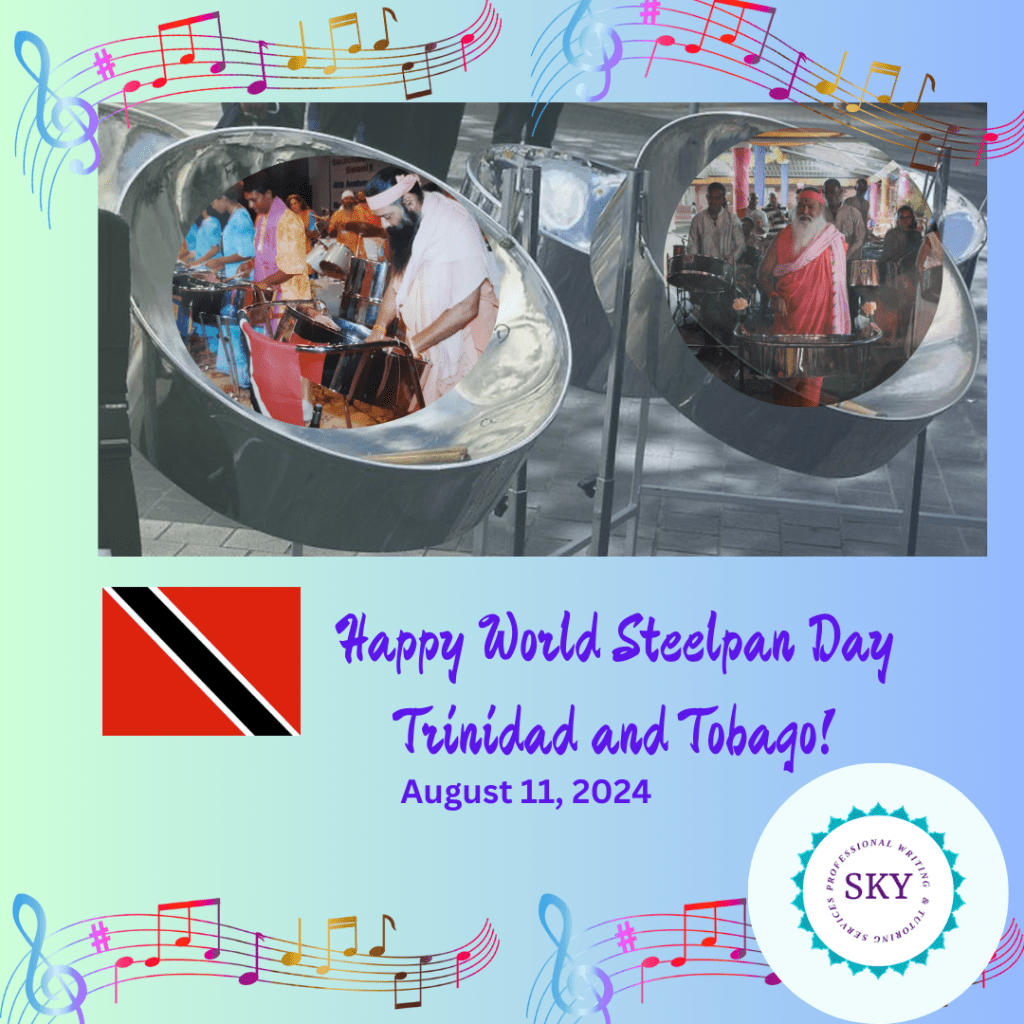
Photo showing the Nada Sangama Steel Orchestra led by His Holiness Parama Pujya Sri Ganapathy Sachchidananda Swamiji

Yes, today, August 11th, 2024, is World Steelpan Day. In recognition of today’s historical significance, this post is dedicated to the steelpan. As such I begin this post by highlighting the Nada Sangama Steel Orchestra led by His Holiness Parama Pujya Sri Ganapathy Sachchidananda Swamiji.

For those who may not be aware, Trinidad and Tobago is the home of the steelpan. This year, on July 3rd, 2024, the steelpan officially became known as Trinidad and Tobago’s national musical instrument following the passage of legislation in Parliament.

Also, for those who may be unaware, the United Nations has now recognized August 11 as World Steelpan Day. Just a few days ago, on August 9, 2024, Trinidad and Tobago achieved another milestone in securing the steelpan as its own when it attained a geographical indicator (GI) for the manufacturing of steelpans. This was approved by the Trinidad and Tobago IP (Intellectual Property) office and therefore gives all steelpan manufacturers and producers the right to affix the GI branding once established standards of production are applied.

The steelpan is an acoustic instrument with a rich cultural history that reflects the creativity and resilience of the people of Trinidad and Tobago. This distinctive instrument, recognized for its unique and captivating sound, has grown from modest origins to become a global symbol of Trinidad and Tobago’s culture and a staple in diverse music genres.

The steelpan’s story dates back to the early 20th century in Trinidad and Tobago. At that time, under British colonial rule, the African descendants who made up much of the population were prohibited from using their traditional drums in their cultural and religious ceremonies. In response to these restrictions, they began experimenting with alternative materials to create new instruments, which eventually led to the creation of the steelpan.

The first steelpans were crafted from discarded oil barrels, which were abundant due to the island’s active oil industry. Musicians would carefully hammer the bottoms of these barrels into concave shapes, with different sizes and depths producing various pitches and tones. This innovative approach laid the groundwork for the steelpan’s development into the instrument we know today.

The 1930s and 1940s were pivotal in the steelpan’s evolution. Innovators like Winston “Spree” Simon and Ellie Mannette played key roles in refining the instrument, exploring different techniques to enhance its sound. Ellie Mannette, often called the “Father of the Modern Steelpan,” was the first to create a steelpan with multiple notes using a full oil barrel, establishing the modern design of the instrument.

As the steelpan continued to develop, its popularity grew. Over the years it has become central to Trinidad and Tobago’s Carnival celebrations, providing the energetic soundtrack to these vibrant festivities. Steelbands are ensembles of musicians playing steelpans of varying sizes and pitches, became a staple of these celebrations and the steelpan became synonymous with Caribbean musical culture. In this post I have also opted to highlight the Phoenix Steel Orchestra which is based in Belmont for the awesome work this very young vibrant band continues to do and both Junior Regrello and Johann Chuckaree who over the recent years have come together to do great work together! I have also opted to highlight Dr Lennox “Boogsie” Sharpe also known as Dr Len Boogsie Sharpe who is a successful and popular composer and arranger of steelpan music.