Posted in Celebrate Today, Celebrating Existence, Celebrating Life, Inspiration & Motivation, Life, Life lessons, Lifestyle, Mindset, Motivation & Mindset

The Freedom Found in Letting Go: Decluttering Every Aspect of Life

When most people hear the word decluttering, they immediately think of overflowing closets, packed drawers, or that room where everything seems to end up “for now.” While clearing physical spaces is certainly beneficial, true decluttering goes far beyond our homes. It reaches into our minds, our hearts, our schedules, our relationships, and even our digital lives.

Sometimes, the things weighing us down aren’t the ones we can see.

There is something incredibly liberating about creating space. Space to breathe. Space to think. Space to grow. Space to appreciate what truly matters. When we intentionally let go of what no longer serves us, we discover that life feels lighter, calmer and more meaningful.

After all, we cannot welcome something new if our hands—and our hearts—are already full.

Decluttering Your Home

Our surroundings have a profound impact on our mood. A cluttered space can often lead to a cluttered mind. While perfection isn’t the goal, creating an environment that is clean, functional and peaceful can make everyday life feel lighter.

Instead of focusing on what you’re giving away, focus on what you’re making room for. Every item you release is one less thing to clean, organise, worry about or maintain.

Keep the things that tell your story, serve a purpose or bring genuine joy. Let go of the things that simply occupy space. A home filled with purpose rather than possessions becomes a sanctuary instead of another source of stress.

Decluttering Your Mind

Our minds carry far more than we realise.

Old worries.

Unfinished conversations.

Past mistakes.

Future anxieties.

Endless to-do lists.

Mental clutter quietly steals our peace before we even realise it’s happening. We replay conversations that ended years ago, worry about situations beyond our control and create imaginary problems that may never exist.

Taking a few moments each day to pray, meditate, journal, practise gratitude or simply sit quietly can help organise our thoughts. We cannot always control what enters our minds, but we can choose what we continue to carry.

Peace often begins where overthinking ends.

Decluttering Your Heart

Perhaps the hardest clutter to release is emotional clutter.

Resentment.

Bitterness.

Guilt.

Regret.

Disappointment.

Holding onto these emotions rarely changes the past—it simply burdens the present.

Forgiveness doesn’t mean forgetting or excusing what happened. Sometimes it simply means refusing to let yesterday continue stealing today’s joy.

Likewise, learning to forgive ourselves is equally important. We are all human. We all make mistakes. Growth comes not from endlessly punishing ourselves but from learning, healing and moving forward with grace.

When we let go of emotional baggage, we make room for compassion, healing and hope.

Decluttering Relationships

Not every relationship is meant to last forever.

Some people enter our lives to teach us.

Some encourage us.

Some challenge us.

Some quietly drift away.

Healthy relationships should bring mutual respect, encouragement and growth. While every relationship requires effort, constantly carrying one-sided friendships or toxic connections can become emotionally exhausting.

Choosing peace over unnecessary drama isn’t selfish—it is self-respect.

At the same time, decluttering relationships doesn’t always mean letting people go. Sometimes it means letting go of unrealistic expectations, old misunderstandings or keeping score. It means investing our energy in the people who genuinely care, encourage and walk beside us through life’s seasons.

Relationships flourish when they are nurtured with love, kindness, patience and presence.

Decluttering Your Schedule

Being busy is not the same as being productive.

Many of us wear busyness like a badge of honour, filling every hour until there’s no room left to simply exist.

Sometimes the healthiest word we can say is “no.”

No to commitments that overwhelm us.

No to unrealistic expectations.

No to constantly pleasing everyone else at the expense of ourselves.

No to believing that our worth is measured by how busy we are.

When our calendars reflect our values instead of our obligations, life feels far more balanced. We create room for rest, family, creativity, personal growth and the moments that truly matter.

Decluttering Your Digital World

Our phones have become extensions of ourselves.

Thousands of photos we’ll never revisit.

Unread emails.

Unused apps.

Constant notifications.

Hours spent scrolling without intention.

Digital clutter quietly competes for our attention every single day.

Cleaning up our digital spaces can be surprisingly refreshing. Unsubscribe from emails you never read. Delete apps you no longer use. Organise your files. Limit unnecessary notifications. Curate your social media feeds to include content that inspires rather than drains you.

Remember, just because information is available twenty-four hours a day doesn’t mean we need to consume it all.

Your attention is one of your greatest resources. Protect it wisely.

Decluttering Your Expectations

Sometimes the greatest clutter comes from the expectations we place upon ourselves.

We expect perfection.

We compare ourselves to others.

We believe we should have everything figured out by now.

We chase impossible standards that leave us feeling like we are always falling short.

Life rarely unfolds according to our carefully crafted timelines.

Perhaps we need to release the pressure of having all the answers and instead embrace the beauty of simply taking the next faithful step.

Progress has always been more valuable than perfection.

Decluttering Your Spirit

Just as we care for our homes and our bodies, our spirits also need tending.

Taking time to reconnect with God, with nature, through prayer, meditation, uplifting music, acts of kindness or moments of quiet reflection can restore what the busyness of life slowly erodes.

When our spirits are nourished, we respond differently to life’s challenges. We become calmer. Kinder. More patient. More grateful.

The more we make room for God, gratitude and grace, the less room there is for fear, anger and negativity.

Joy often arrives quietly, in the spaces we intentionally create.

Decluttering Your Life

Decluttering is ultimately about living intentionally.

It’s about asking ourselves difficult but necessary questions.

What habits no longer serve me?

What beliefs are holding me back?

What fears keep me from moving forward?

What distractions steal my time?

What possessions own me more than I own them?

These questions invite us to examine not only what fills our cupboards but also what fills our lives.

Sometimes the heaviest things we carry cannot be placed into a donation box. They are invisible burdens that quietly shape how we think, feel and live.

The beauty of decluttering is that every small step creates space for something better.

Less Really Can Be More

Decluttering isn’t about owning less simply for the sake of minimalism.

It’s about making room for what truly matters.

More peace.

More gratitude.

More purpose.

More meaningful relationships.

More time.

More joy.

Life has a way of filling every available space if we let it. Every so often, we need to pause and ask ourselves:

What am I holding onto that is no longer serving me?

The answer may surprise you.

Perhaps it’s an old grudge.

Perhaps it’s fear.

Perhaps it’s the pressure to be perfect.

Perhaps it’s simply too much stuff.

Whatever it is, releasing it may be the first step towards living more intentionally and more joyfully.

Decluttering is not a one-time event but a lifelong practice. As we grow, our priorities change, and so should the things we choose to carry. By regularly letting go of what no longer aligns with who we are or who we hope to become, we create room for new opportunities, deeper relationships, greater peace and a renewed appreciation for life’s simple blessings.

After all, a life weighed down by excess leaves little space for wonder. But a life lived with intention, gratitude and purpose has room to flourish.

So today, take one small step.

Clear one drawer.

Release one worry.

Forgive one hurt.

Decline one unnecessary obligation.

Delete one distraction.

Speak one kind word.

Spend one extra moment with someone you love.

Whatever you choose, let it be the beginning of making space for the life you truly deserve.

Because sometimes the greatest transformation doesn’t come from adding something new to our lives—it comes from having the courage to let something go.

“Decluttering isn’t about getting rid of what you have. It’s about making room for what truly matters. When we release what no longer serves us, we create space for peace, purpose, gratitude and joy.”

May we all find the courage to let go of what weighs us down, the wisdom to hold onto what truly matters, and the grace to embrace a life that is lighter, richer and filled with purpose.

Celebrate existence by living lightly, loving deeply and making room for what truly matters.

Posted in Celebrating Life, Life, Life lessons, Lifestyle, Mindset, Motivation & Mindset

Curing Foot-in-Mouth Disease

No, I’m not talking about the medical condition.

I’m talking about the kind of “foot-in-mouth disease” that every Trinidadian knows—the moment when you say something with the best intentions, only to realize it wasn’t received the way you meant it. Before you know it, you’re wishing you could grab those words back.

We’ve all had those moments.

Sometimes it’s an innocent joke.

Sometimes it’s an honest opinion.

Sometimes it’s advice given from a place of care.

Sometimes it’s simply making conversation.

Yet somehow, what we intended and what the other person heard are two completely different things.

Life has taught me that good intentions don’t always guarantee good interpretations.

You can genuinely want to help, and someone thinks you’re interfering.

You can offer encouragement, and it’s taken as criticism.

You can ask a question out of concern, and it’s seen as being too inquisitive.

You can speak with a sincere heart, and your motives are questioned.

The reality is that once words leave our mouths, they no longer belong to us. They belong to the person receiving them, and everyone hears through the filter of their own experiences, beliefs, emotions, and circumstances.

As Trinidadians, we laugh and say, “Yuh put yuh foot in yuh mouth.”

But the older I get, the more I realize that the cure isn’t becoming afraid to speak.

It’s becoming wiser about when to speak, what to say, and perhaps most importantly… who to say it to.

Not everyone deserves access to your thoughts.

Not everyone understands your heart.

Not everyone is listening to understand. Some are listening to respond. Others are listening to judge. And some have already decided what they believe before you’ve even finished speaking.

That doesn’t make them bad people.

It simply means we must learn discernment.

I’ve learned that not every conversation requires my opinion.

Not every misunderstanding requires an explanation.

Not every accusation deserves a defence.

Not every silence needs to be filled.

There comes a point where you realize that protecting your peace is more important than proving your point.

So these days, my approach is much simpler.

I smile.

I greet people warmly.

I wish them well.

I celebrate their successes.

I pray that life treats them kindly.

Then I quietly continue on my way.

I’ve discovered that there is tremendous freedom in staying to yourself—not because you’ve become unfriendly, but because you’ve become selective with your energy. You begin to value peace over unnecessary conversations and quiet confidence over constant explanations.

The people who truly know you don’t need endless explanations to understand your heart.

And those who have already chosen to misunderstand you may never be convinced, no matter how carefully you explain yourself.

That isn’t something to become bitter about.

It’s simply something to accept.

One of the greatest forms of wisdom is knowing where your words will be appreciated and where your silence will serve you better.

Silence isn’t weakness.

Silence isn’t defeat.

Silence is often protection.

It protects your peace of mind.

It protects your relationships from needless conflict.

It protects your energy from being drained by conversations that lead nowhere.

And sometimes, it even protects your reputation better than any explanation ever could.

Before I speak now, I often ask myself:

  • Is it true?
  • Is it necessary?
  • Is it kind?
  • Is this the right person?
  • Is this the right time?

If the answer isn’t clear, I choose silence.

Because peace is precious.

Not every battle is yours to fight.

Not every opinion needs correcting.

Not every misunderstanding needs fixing.

Sometimes, the safest place for your words is within your own heart.

And if I do happen to put my foot in my mouth?

I’ll acknowledge it.

I’ll apologise if I’ve caused hurt.

I’ll learn from it.

Then I’ll move forward with a little more wisdom than before.

Perhaps the real cure for foot-in-mouth disease isn’t finding better words.

Perhaps it’s learning that silence has a voice of its own.

A smile can say enough.

A kind heart doesn’t always need to be explained.

A quiet life is often a peaceful life.

So smile.

Wish others well.

Stay humble.

Stay kind.

Stay true to yourself.

And when necessary, stay silent.

Because sometimes, protecting your peace of mind is the wisest conversation you’ll never have.

Posted in Being Prayerful, Celebrate Today, Celebrating Existence, Celebrating Life, Helping Others, Inspiration & Motivation, Life, Life lessons, Lifestyle, Love and Blessings, Mindset, Motivation & Mindset

Protecting Your Peace of Mind: Valuing Your Worth

One of the most important lessons I have learned is that protecting your peace of mind is not selfish—it is necessary. In a world that constantly demands our time, energy, attention, and emotional resources, it is easy to lose sight of our own well-being while trying to meet the expectations of others.

Many of us spend far too much time seeking validation, understanding, appreciation, or acceptance from people who may never be willing or able to give it. We answer messages that go unanswered, extend kindness that is not reciprocated, and continue investing in relationships that leave us feeling drained rather than fulfilled. While kindness and compassion are admirable qualities, they should never come at the expense of our self-worth.

Valuing your worth begins with recognizing that your time, energy, and emotional health are valuable resources. Not everyone deserves unlimited access to them. The people who truly value you will respect your boundaries, appreciate your efforts, and make you feel seen and heard. Healthy relationships—whether personal or professional—are built on mutual respect, consideration, and reciprocity.

Protecting your peace of mind sometimes means accepting difficult truths. It may mean realizing that not everyone will understand you, support you, or choose to walk beside you on your journey. It may mean stepping back from situations that create unnecessary stress or distancing yourself from those who repeatedly disregard your feelings. While these decisions can be uncomfortable, they often create space for healthier connections and greater personal growth.

One of the most empowering things we can do is stop measuring our value by the actions of others. Someone else’s inability to recognize your worth does not diminish it. Your value is not determined by how quickly someone responds to your message, whether they include you in their plans, or how much attention they give you. Your worth exists independently of external validation.

When you begin to value yourself, your priorities shift. You become more selective about where you invest your energy. You learn to say no without guilt. You stop chasing people who are determined to remain distant. Most importantly, you begin to cultivate a sense of inner peace that is not dependent on the approval or behaviour of others.

Protecting your peace of mind is not about shutting people out; it is about choosing what you allow into your life. It is about creating boundaries that honour your well-being and surrounding yourself with people, experiences, and opportunities that align with your values.

Life is too precious to spend it constantly questioning your worth. Choose the relationships that nourish your spirit. Choose the environments that allow you to grow. Choose the thoughts that encourage rather than diminish you. And above all, remember that valuing your worth is one of the greatest acts of self-respect you can practice.

Your peace matters. Protect it. Your worth matters. Never forget it.

Posted in Celebrating Existence, Life, Love and Blessings

17 Promises I Choose to Live By : Then & Now

Truth be told this is my then followed by my now.

The then was created some 10 years ago:

My personal code of ethics: Statement of Purpose:

This is a personal guide which will serve as a source of inspiration and as a reminder of things I must always be mindful of, especially when I am faced with challenges. It will help me to realise my long-term goals and mirrors my beliefs and my values.

What function is this expected to serve in my life?

This will serve as a daily reminder of what I believe in and a source of encouragement that will help me to become a better well-rounded individual who endeavours to be happy, have peace of mind, and be the best that I can be. I sincerely promise to use the ‘I will’ list below to do that.

Personal Commitments

  1. I will remember, ‘Carpe diem!’ (Seize the day!) and let it be my motto.
  2. I will continue to treat others in the very same manner that I would like to be treated.
  3. I will continue to develop myself professionally.
  4. I will try to inculcate good values and morals in those I interface with (including those under my charge).
  5. I will always be mindful that some things cannot be changed; that is, not everything is within my reach, and I must accept them for what they are… simply, ‘Don’t worry about what you cannot change’ and ‘Qué sera sera!’ (Whatever will be will be).
  6. I will always thank God for my blessings. I have faced many challenges and overcome each of them—such as not being able to hold things, write properly at times, or walk properly. To date, I have 12 O’ Levels, 4 A’ Levels, a BA in English, and my BA in Mass Communication is my second degree. I have a full-time job now. I can look back and say I’m happy with some of the things I did and encourage others to turn their challenges into successes.
  7. I will continue to give credit where credit is due… everyone deserves to be appreciated.
  8. I will continue to move ahead with realistic goals. Thankfully, both my sense of maturity and being realistic have helped me value the relationships I build.
  9. I will continue to remember that everything happens for a reason… it makes it easier to walk around with less emotional baggage and eliminates chances of dumping it on others.
  10. I will continue fulfilling the responsibilities entrusted to me because shirking responsibilities means denying others their rights.
  11. I will always do my best in all that I do rather than giving up before starting or giving up in the middle of what I am doing because the end will be closer in sight.
  12. I will always look for something positive out of every negative experience, and I will use the ‘scissors of life’ to cut out negativity. Negativity breeds negativity and vice versa.
  13. I will use great care, consideration, and dedication to my values and morals to find amicable solutions to problematic situations and ethical dilemmas by always considering the consequences of my actions as it relates to all my dealings and those affected.
  14. I will focus on improving my health and try to get the required amount of rest because if I do not take care of myself, I cannot take care of anyone needing my help.
  15. I will continue to develop my spirituality and be a devotee of God.
  16. I will try to exercise good judgment at all times.
  17. I will review my personal code of ethics periodically and strive to make necessary improvements where possible.

This is my now: Living My Personal Code of Ethics

Life is about the values that guide you through both the highs and the lows. My personal code of ethics isn’t just a list I wrote once; it’s something I try to live by every day.

At the core of everything is a simple mindset: Carpe diem—seize the day. I try to make the most of every opportunity while remembering to treat others the way I would like to be treated. Respect, kindness, and fairness are not optional; they are the foundation of every meaningful interaction.

Growth is also important to me. I continue to develop myself professionally while encouraging and guiding those I interact with, especially those under my care. At the same time, I’ve learned to accept that not everything is within my control. Some things simply are what they are, and finding peace in that—embracing the idea of “what will be, will be”—has helped me tremendously.

Gratitude plays a huge role in my life. Despite the challenges I’ve faced, I remain thankful. Those experiences have shaped me, strengthened me, and allowed me to encourage others to turn their struggles into success. They remind me that resilience is built, not given.

As I move forward, I focus on being realistic, appreciating others, and valuing the relationships I build. I remind myself that everything happens for a reason, which helps me let go of unnecessary emotional weight and avoid passing negativity on to others.

Responsibility is another principle I take seriously. Fulfilling what is entrusted to me matters because failing to do so affects others. That’s why I always strive to give my best, even when it’s difficult, because every step forward brings me closer to the end goal.

I also make a conscious effort to find positivity in every situation. Life will always present challenges, but I believe in cutting out negativity and choosing a mindset that promotes growth and peace.

In dealing with others, I aim to act with care, integrity, and fairness. Ethical decisions aren’t always easy, but considering the impact of my actions helps me navigate even the most difficult situations.

Equally important is taking care of myself. I’ve learned that I cannot pour into others if I am running on empty. Rest, health, and balance are not luxuries—they are necessities.

My spirituality continues to guide me, grounding me in faith and helping me stay aligned with my values. Alongside this, I strive to exercise good judgment in all that I do.

Finally, I remind myself that growth is ongoing. I revisit my values, reflect on my actions, and make adjustments where needed. Becoming better is a continuous process, not a final destination.

Posted in Celebrating Life, Life, Life lessons, Mindset

Why “What Is” Is Better Than “What Ifs”

There is a quiet habit many of us fall into without even realizing it. It begins with a simple question: what if?

What if I had made a different decision?
What if I had said something sooner?
What if things had unfolded another way?
What if someone had chosen differently?

At first, these thoughts seem harmless. They feel like reflection, like the mind trying to make sense of something that did not turn out the way we once hoped. But if we are honest with ourselves, what ifs can slowly become a place where we spend far too much time.

A place where the mind keeps circling back, trying to recreate a version of life that never actually existed.

The problem with what if is that it lives entirely in imagination. It is a space where the story can always be rewritten, where the outcome can always be softer, kinder, or more favorable than what really happened. In that imagined version, the timing works out better. People say the right things. Circumstances align in ways that feel perfect.

But life rarely unfolds like that.

Real life is layered. It is complex. It carries moments of joy, moments of disappointment, unexpected detours, and lessons that sometimes only make sense much later. And that is where what is becomes far more powerful than what if.

Because what is is grounded in reality.

What is is the life you are living right now — the one shaped by every decision, every experience, every closed door and every open one. It may not always look like the version you once imagined, but it carries something much more valuable than imagination: truth.

Truth gives you something to stand on.

When you accept what is, you give yourself the opportunity to grow. You begin to see situations more clearly, without the soft filters that what if tends to place over the past. You begin to understand why certain things unfolded the way they did. Sometimes you realize that what you once thought was a loss was actually a redirection.

And sometimes you realize that the version you were holding onto in your mind was never as perfect as it seemed.

Our minds have a way of editing memories. When we think about what might have been, we often remove the difficult parts and highlight only the pieces that feel comforting. Suddenly the imagined version of events becomes far more appealing than the reality we experienced.

But that imagined version is incomplete.

It does not include the challenges that would have come along with it. It does not include the lessons you might have missed, the strength you might never have developed, or the growth that came from navigating the situation as it actually happened.

And growth is one of the most valuable gifts that what is gives us.

Life shapes us through real experiences, not imagined ones. Through moments where we learn to adapt, adjust, and sometimes rebuild. Through times where we are forced to see things differently, to let go of expectations we once held tightly, and to open ourselves to paths we had not considered before.

There is a quiet strength that comes from accepting reality as it is.

Acceptance does not mean you agree with everything that happened. It does not mean you pretend certain moments did not hurt or that disappointments did not matter. Acceptance simply means you stop trying to rewrite a chapter that has already been written.

It means you stop asking what if and begin asking, what now?

That shift is powerful.

Because the moment you start focusing on what now, your energy returns to the present — the only place where real change can actually happen.

You begin to notice the opportunities that exist right in front of you. The small openings that were always there but may have gone unnoticed while your attention was focused on the past. The new connections, ideas, and possibilities that can only emerge when you are fully present in the life you are living.

And sometimes, as time passes, something surprising happens.

You begin to see that the life you once questioned has quietly become a life that fits you better than the one you imagined. The detours that once frustrated you start to make sense. The doors that closed reveal the paths they cleared for you to walk.

Not everything that did not happen was meant to happen.

Not every opportunity that slipped away was meant to stay.
Not every person who left your life was meant to remain in your story.

Some things were simply stepping stones — moments that guided you toward where you were meant to be next.

That is why what is holds so much quiet wisdom.

It grounds you in the present. It invites you to learn from what has already unfolded. It allows you to build something meaningful from the life you are actually living rather than the life that only exists in imagination.

And when you begin to truly embrace what is, something within you softens.

You stop fighting the past.
You stop measuring your life against imagined outcomes.
You stop carrying questions that can never truly be answered.

Instead, you begin to appreciate the richness of the life that is unfolding right now — imperfect, surprising, and sometimes even better than what you once thought you wanted.

Because the truth is, the present moment holds far more possibility than what if ever will.

What if can only look backward.

But what is has the power to move your life forward.

Posted in Life lessons, Mindset, personal growth, self-care

Celebrating Truth: Respect Costs Nothing, But Means Everything

You ever notice how a few simple words can completely change someone’s day? A kind tone, a little patience, a bit of respect—it goes a long way. And yet, somehow, it’s also one of the easiest things for people to forget.

Treating others the way you want to be treated isn’t just some old saying we leave behind in primary school—it’s a principle that actually shapes the kind of person you become. The way you speak to people, the way you respond when you’re annoyed, the way you carry yourself in everyday interactions… all of it matters more than we sometimes realize.

Because here’s the truth—people may not remember every single thing you say, but they will always remember how you made them feel.

And let’s talk honestly for a moment about something we see way too often— speaking down to others. That tone. That attitude. That subtle (or not-so-subtle) feeling of “I’m better than you.” It might seem small in the moment, like just a quick reaction or a passing comment, but it leaves a lasting impression. Words have weight, and when they’re delivered with disrespect, they can stick with someone far longer than intended.

Sometimes people speak down to others without even realizing it. Maybe it comes from frustration, stress, or even insecurity. But no matter the reason, it doesn’t make it right. Everyone deserves to be spoken to with basic human decency—no exceptions.

Respect isn’t something you give only to people you like, or people who have a certain status, or people who can benefit you. Real respect is consistent. It shows up in how you treat the cashier, the classmate who struggles, the coworker who made a mistake, or even the stranger who crossed your path for just a moment.

Being kind and respectful doesn’t make you weak—it actually shows strength. It takes maturity to pause before responding harshly. It takes self-awareness to check your tone. And it takes character to choose kindness, even when you’re not in the best mood.

Think about it—how do you feel when someone speaks to you with attitude? When they dismiss you, belittle you, or make you feel small? It doesn’t feel good. So why pass that feeling on to someone else?

Treating others the way you want to be treated is really about empathy—putting yourself in someone else’s position, even if just for a second. It’s about asking yourself, “Would I be okay if someone spoke to me this way?” And if the answer is no, then you already know what needs to change.

The world is already filled with enough negativity, criticism, and pressure. You don’t have to contribute to that. In fact, you have the power to do the opposite—to be someone who lifts others up instead of tearing them down.

And here’s something important—being respectful doesn’t mean letting people walk all over you. You can still set boundaries. You can still stand up for yourself. But there’s a difference between being firm and being disrespectful. One shows confidence, the other reflects poor character.

5 Simple Ways to Treat People Better:
Pause before you respond – Not every reaction needs to be immediate. Take a second to think about your tone.
Watch how you speak, not just what you say – Your delivery matters just as much as your words.
Put yourself in their shoes – A little empathy can completely change your response.
Be polite in small moments – Saying “please,” “thank you,” and “excuse me” still matters.
Correct without belittling – You can address mistakes without making someone feel small.

At the end of the day, how you treat people says more about you than anything else ever could. It reflects your values, your mindset, and the kind of energy you bring into the world.

So choose your words carefully. Choose your tone wisely. Choose kindness, even when it’s not the easiest option.

Because it truly costs you nothing to treat people right—but it can mean everything to someone else

Posted in Celebrate Today, Celebrating Life, Life, Love and Blessings

Celebrating your journey, even when your heart needs a moment

Life has a quiet way of teaching us lessons we didn’t expect to learn, even when we don’t think or realize we need it or we are up to it.

Sometimes everything feels like it is moving along just fine. You are making plans, setting goals, doing what you need to do, and finding your rhythm. Then something shifts. A situation changes. A door closes. Someone you thought would always be there is suddenly not. Or maybe nothing dramatic even happens — things simply begin to feel a little different, a little heavier, a little uncertain.

And in those moments, one gentle truth often reveals itself: you need to keep moving forward.

Not in a rushed or forceful way. Not in the sense that you must pretend everything is fine when it isn’t. But in the quiet understanding that life continues, and so must you.

There will be seasons where things do not go the way you hoped. Moments where you sit with your thoughts a little longer than usual, trying to understand what changed or why something unfolded the way it did. It is human to reflect, to replay conversations, to wonder if things might have been different under other circumstances.

And that reflection is not wrong.

In fact, allowing yourself to feel what you feel is one of the healthiest things you can do.

There is nothing weak about acknowledging that something hurt you, disappointed you, or caught you by surprise. Life would be far easier if we could simply switch emotions on and off, but that is not how we are built. Our feelings exist for a reason. They remind us of what matters to us. They show us where we have invested our time, our energy, and sometimes our hearts.

So if something affects you, it is perfectly okay to pause and acknowledge it.

You can admit that a situation did not feel good.
You can recognize that someone’s actions left you disappointed.
You can accept that things did not turn out the way you hoped they would.

None of that means you are stuck.

Acknowledging your feelings is not the same as living in them forever. It simply means you are being honest with yourself. It means you are giving yourself the grace to process what happened instead of pretending it did not matter.

But after that moment of honesty, something else gently calls you forward.

Life still has things waiting for you.

There is still work to do.
Still goals to pursue.
Still moments ahead that you have not yet experienced.

And so, with quiet strength, you gather yourself and continue.

Keeping moving does not always mean making big, dramatic changes. Often it looks much simpler than that. It looks like getting up the next day and doing what needs to be done. It looks like continuing to show up for your responsibilities. It looks like slowly redirecting your energy toward the things that help you grow.

Progress, more often than not, is quiet.

It is made up of small decisions that no one else really sees. The decision to let go of what you cannot control. The decision to stop replaying a moment that has already passed. The decision to protect your peace and invest your energy where it truly belongs.

Sometimes keeping moving means leaving certain spaces behind. Sometimes it means adjusting expectations you once held tightly. And sometimes it simply means reminding yourself that one difficult chapter does not define the rest of your story.

Life has a beautiful way of opening new paths when we are willing to keep walking.

You may not always know exactly where the road will lead. There will be moments when you are simply taking one step at a time, trusting that clarity will come as you go. And often, it does.

Every step forward creates space for something new. Every step helps you grow a little stronger, a little wiser, a little more grounded in who you are becoming.

One day you may look back and realize that the moments that once felt like pauses were actually quiet turning points — moments that gently guided you toward something better suited for your journey.

That is why it is important to keep moving.

Not hurriedly.
Not forcefully.
But steadily and with grace for yourself.

Feel what you need to feel.
Acknowledge the moments that mattered.
And then continue doing what life is asking of you.

You do not have to have everything figured out today.

You simply have to take the next step.

And then the next.

Just keep moving.

Posted in Celebrating Existence, Celebrating Life

Celebrating the Life of My Grandmother

As they say, the loss of a loved one is a a void that cannot be filled and the memories we have are our comfort. My grandma was not just my grandma but she was special. Growing up I didn’t know my Dad’s mom because she passed away before my parents got married. She was my Mom’s mom Grand-mom and she wore many hats.

To lose a grandmother is to lose an anchor in the family — the keeper of traditions, the storyteller of generations, the one whose love reached beyond time. Her absence leaves an empty chair, but her presence lingers in every word she shared, every prayer she once whispered. Though her hands have rested, her legacy continues — in the lives she shaped, in the love she sowed, and in the strength she passed down.

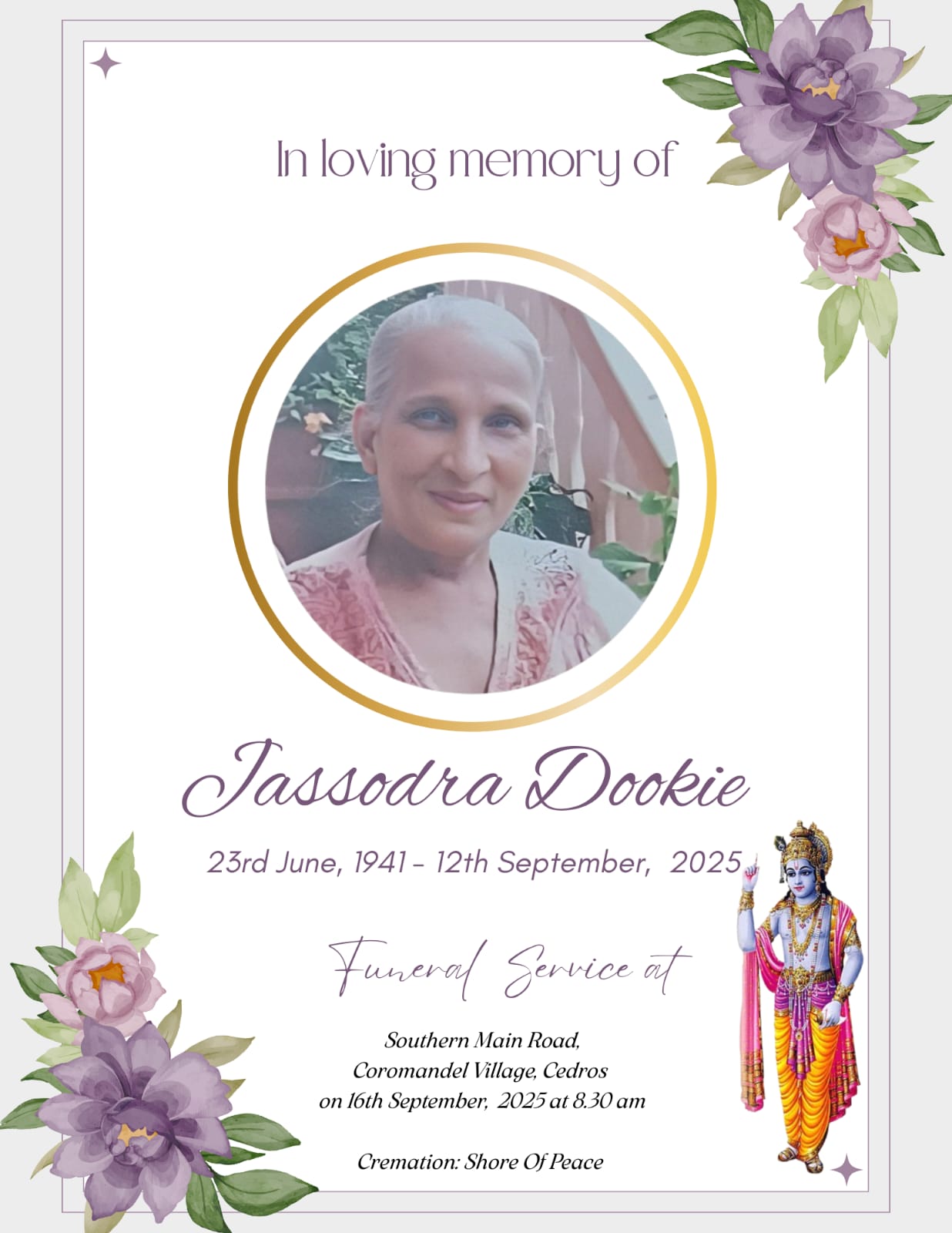
My grandmom, the late Jassodra Dookie was known by many as Celia or Lady Celia. Many know her as the lady who sold plantain in the Point Fortin Market for many years. Many in the village would remember the early mornings when she and my Grandfather would toil in their garden and they also did that for many years. That in summary captures their hardworking nature and as they got older, that became something they both had to ease up doing. They were a team and they worked together.

She was a very giving person and this is one of the many things she will be remembered for. Her life was filled with giving and giving freely. So, let me ask: Is there a story in a name? “Jassodra”

Putting together pieces, one could infer that:

“Jassodra” might be a variant or relative of Jasoda/Yashoda.

If so, it might carry similar resonances: mother-figure, someone with goodness or kindness.

For as far back as I could remember, as mentioned my Grandma was a very hardworking woman. This hard work was a rhythm she lived by through her entire life and she was very independent in that she did what she needed to. Whether in her home or in her garden, or in the market, she poured herself fully into every task. Her life was filled with giving and giving freely. More so, when you caught her laughter or her smile, know it was one to treasure.

Her love was not quiet—it was felt in the way she welcomed people and she loved giving advice because this was her very nature. She was a daughter, sister, wife, mother, grandmother, great-grandmother, aunt, niece, cousin and friend of many. 

While we as her grandkids have lost a grandmother, her sisters have lost their eldest sister, my Mom and her siblings have lost their Mom, our kids have lost their great- grandmom, her nieces and nephews have lost an aunt, and yes, I could go on, but I am saying all of this to stress on the fact, that she will not be forgotten. Memories of her will bring comfort to those taking the lessons her life taught us and putting them to good use.

She loved to read and at times was known for a joke or two. Those who knew her knew she always bought newspapers and when she didn’t, would still get the newspapers to read. She showed us that strength is found not in the size of what you have, but in the care and effort you put into what you do.

Perhaps yes, her greatest gift was generosity. My grandmother gave freely and she never hesitated to share whatever she had, no matter how big or small.

Today, we celebrate her life not only with memories but with the lessons she leaves behind.

My grandmother may no longer be with us in person, but her spirit lives in our acts of love, every hard-earned success, every act of kindness we extend to others. Her life was a blessing, and her memory is a legacy we carry forward with gratitude.

Jassodra Dookie, also known as Celia, will be lovingly remembered as:

Daughter of: Puloo & Kola Ramlakhan (both deceased)

Wife of: Ramlal Dookie (deceased)

Mother of: Doris, Dora, Dolsie, Bena, Jaggernauth, Rajdaye & Kaysika Devi (deceased)

Sister of: Betty, Sita, Vinda, Rookmin (deceased), Sookraj (deceased), Doodnath (deceased) & Bharose (deceased)

Grandmother of: Rachael Ann, Ria, Ricky, Sasha, Adesh, Rishi, Imran, Candice, Sarah Lynn, Vincent, Leah, Premnauth, Susan, Joseph & Josiah

Great Grandmother of: Richie Lee, Kaytlyn, Yadu Datta, Regan, Rayaz, Renissa, Ezra, Marissa, Amelia, Alissa, Sofia, Stephon, Emma, Levi, Enoch, Lilly Ann & Lucas

Granddaughter of: Sonia & Ramnauth Sadoo

Aunt of: Merlin, Anjie, Anita, Sharda, Ria, Pradeep, Manoj, Michael, Nina, Stephen, Vishal, Roopa, Deepa, Narvin, Nellie, Indar & many others

Cousin of: Rose, Baby, Jai, Deokie, Sai, Vihar & many others

Niece of: Uncle Premchand Mahabirsingh

Daughter-in-law of: Gobin Dookie

Mother-in-law of: Winston, Rajesh, Hosein, Rosemarie, Sharaz & Ramjit (deceased)

Sister-in-law of: Ram & Ashford

Relative of: the Dookie’s, Atal’s & many others

Friend of: Tanty Golly, Doolin & many others

The passing of a loved one reminds us of life’s preciousness. It teaches us to cherish every moment, to express love and gratitude without delay, and to forgive where we can. Life is fleeting, and in its impermanence, we learn to focus on what truly matters—relationships, kindness, and leaving a positive mark on the world. Though loss brings pain, it also brings clarity: to live with purpose, to embrace the small joys, and to treasure the memories that keep those we love alive in our hearts.

Some meaningful lessons include:

  1. Value Time: Life is short, so spend time on what truly matters—family, friends, passions, and experiences.
  2. Express Love and Gratitude: Don’t wait to say “I love you” or “thank you.” People may not always be around.
  3. Live with Purpose: Death reminds us to live intentionally and make a positive impact while we can.
  4. Embrace Forgiveness: Holding grudges wastes precious energy; life is too short to carry anger.
  5. Appreciate the Small Things: Everyday moments—laughter, nature, a kind word—gain significance when we reflect on life’s fragility.
  6. Acceptance of Impermanence: Life is fleeting; learning to accept change and loss brings peace.
  7. Leave a Legacy: Our actions, love, and memories live on in others—focus on what you want to be remembered for.
  8. Prioritize Health and Well-being: Life’s unpredictability teaches us to care for ourselves and others.
Posted in Celebrating Existence, Celebrating Life

Forever in Our Hearts: Remembering My Dad

Today is seven (7) years since the day our dad, Ramchit Ramesh Thomas, passed away When he passed away on September 15, 2018, it changed all our lives not because we are unaware of what death is but because it added a whole new reality. Although he is physically gone, his presence is still deeply felt in our lives. Not a day goes by when he is not thought of. Time has moved forward, but the love, lessons, and memories he left behind remain with us as powerful as ever.

As I once wrote: “Dad was my hero.” That truth has not changed. If anything, with each passing year, I appreciate even more the man he was, the values he lived by, and the legacy he left for us. I miss him and we all do, but we know he is in no more pain, and he fought a brave fight, standing with integrity and courage till the very end. For me, I remember our conversations, his last words to me, his last hours, his final moments and all that came before that in the live he lived.

A Man of Integrity

Daddy lived by every message he shared with us. Preparation, discipline, honesty, and hard work guided everything he did. He believed in showing up, being ready, and following through. Those lessons still echo in my life every single day.

What few would know would be how committed he was to ensuring that there was electricity in Coromandel.

While I provide the image from the 1985 article, allow me to share snippets from it:

In my 2024 Father’s Day reflection, I wrote about how much he shaped me: “Dad’s love was not just in words, but in his actions, in his sacrifices, in his unwavering dedication to his family.” Those words still ring true because his example continues to guide how I live, love, and serve.

A Life of Giving

Those who knew him would know that this is who he was. Dad gave so much of himself—not only to us, his family, but also to the people around him. He always found a way to help, whether through his roles in the community or in the quiet, simple ways he supported those in need.

Those who knew him would be able to recall that the Coromandel Shiv Mandir was very dear to him and in the 20 years he served as President, he remained every committed to ensuring that the structure was continuously improved and the amenities too. Mom was always by his side and continues to be present in the Mandir. He wanted it to be a place where devotees who attended the Mandir- whether they were from the community or were visiting- could be in a safe space and worship in comfort. Over the years, the progress he made in realizing this dream became more and more evident. Thankfully, he was able to see a lot of it!

One story I did not share much is that last year when I began my playwright incubator’s course, the play I wrote earned its title from a part of Daddy’s life post-retirement. This play made it to the final round of staged readings in Barbados at the Daphne Joseph Hackett Theatre. The play is titled, “Shattered Dreams and Silver Linings”. It is a major undertaking but also one I will continue to work on to share my Dad’s story with the world.

In my 2018 tribute, I wrote: “He was selfless, dedicated, and disciplined. He gave of himself without ever expecting anything in return.” That is who he was at his core. Even when he was ill, he continued to encourage and support others. He taught us that true strength is not measured in what you keep for yourself, but in what you give to others.

The Little Things I Miss

When I think of Daddy, I remember not only the big lessons but also the quiet, everyday moments:

  • His smile that could light up a room.
  • His laughter that brought joy into our home.
  • His encouraging words that reminded me of my own strength.
  • His stories, filled with wisdom and sometimes humor, that connected us to our roots.
  • The way he showed us to reason situations.
  • The way he taught us to remain calm.
  • His love for each of us.
  • His passion for all that he did.

Those simple, ordinary moments are treasures now. They are reminders of his presence, even when he is no longer here physically.

His Legacy Lives On

In 2024, I shared that “Even though he is no longer here, I honour him by living the values he instilled in me—integrity, kindness, humility, and perseverance.”

That remains my daily goal. Every time I face challenges, I hear his words about preparation. Every time I choose kindness, service, or honesty, I know I am carrying him forward.

Dad would never want us to remain in sorrow. He would want us to live, to give of ourselves, and to walk with courage. That’s how I honor him—with my life, my choices, and my actions.

Forever Remembered

Daddy, we miss you dearly, but we know you are at peace. Your love continues to guide us, your lessons continue to strengthen us, and your legacy continues to shine through all who knew you. He was a gentle giant who touched many lives.

Thank you, Daddy. We love you. We honor you. We will never forget you.

We are grateful for all the time we had with our Dad! Physically gone but never to be forgotten! We are also grateful that we have Mummy with us! We are forever blessed to have them both as our parents!

Posted in Being Prayerful, Celebrate Today, Celebrating Existence, Celebrating Life, Life

To Err Is to Be Human: Celebrating the Power of Learning

To err is human, but every mistake carries a lesson. Discover how embracing imperfection, resilience, and the power of learning can transform your journey of personal growth and self-discovery. These timeless words remind us of something simple yet profound—we are not meant to be perfect; we are meant to be human. And in being human, we are invited into the sacred dance of growth, where mistakes are not failures but faithful companions on our journey of becoming.

The Beauty in Stumbling

Each misstep whispers a lesson. When we stumble, we discover new ways of standing tall. When we falter, we learn the strength of rising again. History itself shows us this truth—every great invention, every bold breakthrough, every step forward came through countless trials, errors, and renewed attempts. Our lives reflect the same rhythm. Mistakes are not detours; they are part of the road itself.

Learning: The Heart of Being Alive

There is immense power in learning. Every error holds a hidden gift, waiting for us to unwrap it with reflection and courage. To learn is to take what once felt heavy and turn it into wisdom. To learn is to transform a wrong turn into a guiding light. The very act of learning proves that we are alive, growing, and endlessly capable of more.

Embracing Our Shared Humanity

When we accept our imperfections, we open ourselves to compassion—both for ourselves and for others. We see that everyone carries their own journey of lessons, victories, and second chances. In celebrating our humanness, we find connection. We realize that what unites us is not perfection, but the courage to keep trying, keep learning, and keep loving despite the stumbles along the way.

Becoming Through Mistakes

To err is to be human. But to embrace those errors as opportunities—to rise, to grow, to learn—that is to truly live. Every mistake can be a stepping stone to something greater, if we allow it to be. So let us celebrate being human, not despite our flaws, but because of them.

For in every error, there is a lesson.
In every lesson, there is growth.
And in every act of growth, there is the miracle of becoming.

Life Lessons I Have Learnt

Through my own journey, I’ve discovered:

  1. Mistakes are not the end—they are a beginning. Every stumble can open the door to a new path.
  2. Self-forgiveness is a form of strength. It is only when I forgive myself that I can move forward with freedom.
  3. Growth takes patience. Learning often comes slowly, but each step forward—no matter how small—matters.
  4. Vulnerability connects us. When I share my struggles, I discover that I am not alone.
  5. Resilience is built through trying again. Courage is not the absence of failure—it is the decision to keep going.

These lessons remind me daily that my humanity is not a flaw but a gift, and that every mistake I make has the power to shape me into someone wiser, kinder, and stronger.