Posted in Celebrate Today, Celebrating Existence, Celebrating Life, Family Moments, Inspiration & Motivation, Life, Love and Blessings

September 6 — A Day in History, Love and Possibility

What is so special about September 6?

Every date on the calendar has a story. Some dates are remembered for important events, remarkable achievements and moments that changed the world. Others become special because of the people and memories we associate with them.

September 6 is one of those dates for me.

As I looked at some of the events, achievements and milestones connected to this day throughout history, I found myself appreciating just how much meaning a single date can hold.
🌍 September 6, 1522 — A journey around the world

On September 6, 1522, the Victoria, the only surviving ship of Ferdinand Magellan’s expedition, returned to Spain, completing the first recorded circumnavigation of the globe.

It was an extraordinary journey of courage, uncertainty and perseverance.

Magellan did not survive the expedition, but Juan Sebastián Elcano continued the voyage and brought the Victoria home.

Sometimes, the greatest journeys are completed because someone chooses to keep going.

⛵ September 6, 1620 — A new journey begins

On September 6, 1620, the Mayflower departed Plymouth, England, beginning the voyage that would become one of the most famous journeys in American history.

It is another reminder that every great journey begins with a first step into the unknown.

👩🏽 September 6, 1870 — A step forward

On this date in 1870, Louisa Ann Swain became the first woman recorded as legally casting a vote in a U.S. election under Wyoming’s new women’s suffrage law.

Her vote became part of the much larger story of women’s political rights.

Progress often begins with one small but significant step.

🛒 September 6, 1916 — An everyday revolution

On September 6, 1916, Piggly Wiggly opened in Memphis, Tennessee, widely recognized as the first self-service grocery store.

Something that seems completely ordinary today was once an innovative idea.

It reminds us that what we take for granted today was once someone’s vision of a better way.

❤️ September 6 — A day of love

September 6 has also been a special day for couples beginning their lives together.

Among those who married on this date are Theresa May and Philip May in 1980, Trinidad and Tobago-born actress and singer Heather Headley and Brian Musso in 2003, and Neil Patrick Harris and David Burtka in 2014.

Different couples. Different stories. One date.

And then there is a September 6 love story that is especially meaningful to me.

On September 6, my parents got married and began a new chapter in their lives.

That day became the beginning of a journey that would eventually include a family, countless memories, laughter, challenges, celebrations and a lifetime of moments that could never be captured by a photograph or recorded in a history book.

Their wedding may not appear in the pages of world history, but it is part of my history.

And sometimes, the most important history is personal.

There are dates that millions of people may know, but there are also dates that belong quietly and profoundly to individual families.

September 6 is one of those dates for me.

🌸 The people born on September 6

September 6 has also given the world many remarkable people, including social reformer and Nobel Peace Prize recipient Jane Addams, inventor Wilson Greatbatch, barcode co-inventor Norman Joseph Woodland, musician Roger Waters, actress Jane Curtin and actor Idris Elba.

Their lives remind us that there are countless ways to make a difference.

Through science.

Through creativity.

Through service.

Through art.

Through perseverance.

Through simply touching the lives of others.

🤍 What September 6 means to me

Perhaps that is what makes September 6 so beautiful.

It is a date connected to journeys, beginnings, progress, innovation, achievement and love.

But beyond everything recorded in history books, it carries something far more personal for me.

It reminds me that before I was here, there was a beginning.

Two people chose each other.

They started a journey.

And from that journey came a family and the life I know today.

I can look at September 6 and see not only an ending, but a beginning.

And perhaps that is the beauty of memory.

Love does not stop being part of our story simply because someone is no longer here to tell their side of it.

Some stories continue through the people who remember.

Some love continues through the lives that grew from it.

And some dates remain forever in our hearts.

✨ September 6, 2026

Today, September 6, is another chapter.

It is a day we are fortunate enough to live.

One day, it too will become history.

Someone will remember this day because of something that happened.

A decision.

A celebration.

A new beginning.

A conversation.

A kindness.

A moment with someone they love.

So today, I choose gratitude.

For journeys completed.

For journeys begun.

For progress.

For innovation.

For love.

For family.

For memories.

For the people who came before us.

And for the privilege of being here to write another chapter.

Every date has a story.

Some are written in history books.

Some are written in the hearts of families.

And some are written in both.

September 6 will always be one of those dates for me. 🤍🕊️🙏🏽

Posted in Indian Arrival Day, Life, Trinidad and Tobago, You Tube

Celebrating 180 Years of Indian Arrival in Trinidad: A Journey of Resilience and Legacy

May 30, 2025, marks a momentous milestone in Trinidad and Tobago’s rich multicultural history — the 180th anniversary of Indian Arrival Day. It is a day to honour the endurance, culture, and contributions of the East Indian community, whose journey began in 1845 with the arrival of the first indentured laborers from India aboard the Fatel Razack.

This historic voyage marked the beginning of a new chapter, not only for those who arrived seeking opportunity, but for the very fabric of Trinidad and Tobago. Over 140,000 Indians would follow over the decades, facing hardship, uncertainty, and cultural displacement. Yet, through resilience and deep-rooted values, they laid the foundation for generations to flourish.

Today, the influence of the Indian community is deeply woven into the national identity — from cuisine, music, and religion, to agriculture, entrepreneurship, and education. Festivals such as Divali, Phagwa, and Indian Arrival Day itself reflect the vibrant legacy passed down through time. Today, Trinidad and Tobago is the home of the 85 ft Sri Karya Siddhi Hanuman Murti which is the tallest murti in the Western Hemisphere and it stands majestically tall at the Sri Dattatreya Yoga Centre in Carapichaima. Today, Trinidad and Tobago it is the home of the Indian Caribbean Museum of Trinidad and Tobago.

Trinidad and Tobago has been profoundly shaped by the contributions of its East Indian population. Over the years, these contributions have enriched the nation’s culture, economy, religion, cuisine, language, and national identity. Here are some key areas where East Indian influence is especially notable:

1. Religion and Spiritual Life

  • Hinduism and Islam took root in Trinidad through Indian indentured laborers, and today, both are integral parts of the country’s religious landscape.
  • Temples and mosques are found throughout the islands, including iconic sites like the Temple in the Sea and Sri Dattatreya Yoga Centre.
  • Religious celebrations such as Divali (Festival of Lights) and Eid-ul-Fitr are national holidays, celebrated by all communities.

2. Festivals and Cultural Celebrations

  • Phagwa (Holi) is celebrated with color, song (chowtal), and community spirit.
  • Divali Nagar is a major annual cultural event, showcasing Indian music, dance, food, and spiritual teachings.
  • Indian Arrival Day (May 30) itself is a public holiday commemorating the arrival and legacy of Indian people.

3. Music and Performing Arts

  • East Indians brought with them musical traditions such as bhajans, chowtal, and classical Indian music, which have evolved into unique Trinbagonian forms.
  • The tassa drum is a lively and powerful musical instrument rooted in Indian tradition and now a staple at weddings, funerals, and cultural events.
  • East Indian dance forms, such as kathak and folk dances, have found a place in schools and community events.
Display for Indian Arrival Day taken at The Price Club in Chaguanas (pic 1)

4. Food and Cuisine

  • Trinidad and Tobago’s food culture has been heavily influenced by East Indian cuisine.
  • Dishes like roti, dhal, doubles, sada and fry aloo, channa and curry, and kurma are now beloved national staples.
  • The use of spices, chutneys, and cooking techniques has created a unique Indo-Caribbean flavor.
Display for Indian Arrival Day taken at The Price Club in Chaguanas (pic 2)

5. Language and Literature

  • Words from Hindi, Bhojpuri, and Urdu have blended into local dialects and expressions.
  • Indo-Trinidadian writers, poets, and scholars have contributed richly to national and Caribbean literature, exploring themes of identity, migration, and memory.

6. Agriculture and Economy

  • Early Indian settlers were primarily employed in agriculture and played a significant role in sustaining the sugar and rice industries.
  • Many Indians became landowners and farmers after indentureship ended, helping to feed and support the growing nation.

7. Education and Public Life

  • Indo-Trinidadians have excelled in education, producing scholars, educators, and professionals across fields.
  • They have contributed significantly to politics, law, and public service, with many serving as national leaders, ministers, and diplomats.

East Indian contributions in Trinidad and Tobago are not only visible—they are foundational. From temples to tassa, roti to resilience, and music to multiculturalism, their legacy continues to shape and define the spirit of the nation.

What exactly did we do? That is, in addition to dressing our kids with East Indian wear. Our daughter needed to choose food or delicacy East Indian brought to Trinidad and Tobago. First, she wanted to prepare alloo pies and yes, we did, but then we decided for her project for her to prepare tilly cake with white till (also known as sesame seeds) which is a sweet prepared for Goddess Saraswati especially for Basant Panchami.

The 180th anniversary is more than a commemoration — it is a celebration of survival, adaptation, and unity. It is also a reminder of the shared history that binds the nation together, where diverse roots grow in harmony.

As we reflect on this milestone, let us pay tribute to the sacrifices of the early arrivals, honor the wisdom of our elders, and continue nurturing a future built on mutual respect and cultural pride.

Happy Indian Arrival Day, Trinidad and Tobago — 180 years strong and thriving.

Posted in Celebrate Today, Celebrating Existence, Life, World Steelpan Day 2024

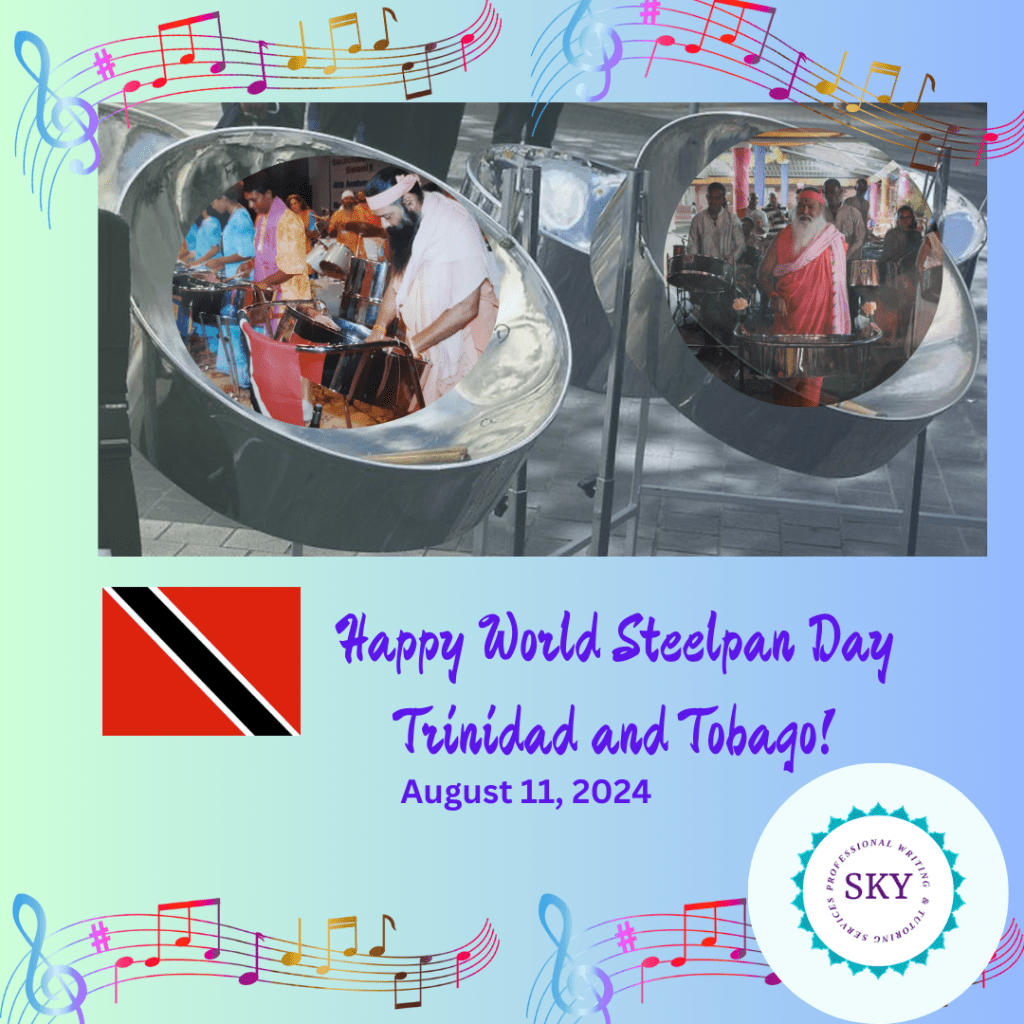
Happy World Steelpan Day 2024!

Photo showing the Nada Sangama Steel Orchestra led by His Holiness Parama Pujya Sri Ganapathy Sachchidananda Swamiji

Yes, today, August 11th, 2024, is World Steelpan Day. In recognition of today’s historical significance, this post is dedicated to the steelpan. As such I begin this post by highlighting the Nada Sangama Steel Orchestra led by His Holiness Parama Pujya Sri Ganapathy Sachchidananda Swamiji.

For those who may not be aware, Trinidad and Tobago is the home of the steelpan. This year, on July 3rd, 2024, the steelpan officially became known as Trinidad and Tobago’s national musical instrument following the passage of legislation in Parliament.

Also, for those who may be unaware, the United Nations has now recognized August 11 as World Steelpan Day. Just a few days ago, on August 9, 2024, Trinidad and Tobago achieved another milestone in securing the steelpan as its own when it attained a geographical indicator (GI) for the manufacturing of steelpans. This was approved by the Trinidad and Tobago IP (Intellectual Property) office and therefore gives all steelpan manufacturers and producers the right to affix the GI branding once established standards of production are applied.

The steelpan is an acoustic instrument with a rich cultural history that reflects the creativity and resilience of the people of Trinidad and Tobago. This distinctive instrument, recognized for its unique and captivating sound, has grown from modest origins to become a global symbol of Trinidad and Tobago’s culture and a staple in diverse music genres.

The steelpan’s story dates back to the early 20th century in Trinidad and Tobago. At that time, under British colonial rule, the African descendants who made up much of the population were prohibited from using their traditional drums in their cultural and religious ceremonies. In response to these restrictions, they began experimenting with alternative materials to create new instruments, which eventually led to the creation of the steelpan.

The first steelpans were crafted from discarded oil barrels, which were abundant due to the island’s active oil industry. Musicians would carefully hammer the bottoms of these barrels into concave shapes, with different sizes and depths producing various pitches and tones. This innovative approach laid the groundwork for the steelpan’s development into the instrument we know today.

The 1930s and 1940s were pivotal in the steelpan’s evolution. Innovators like Winston “Spree” Simon and Ellie Mannette played key roles in refining the instrument, exploring different techniques to enhance its sound. Ellie Mannette, often called the “Father of the Modern Steelpan,” was the first to create a steelpan with multiple notes using a full oil barrel, establishing the modern design of the instrument.

As the steelpan continued to develop, its popularity grew. Over the years it has become central to Trinidad and Tobago’s Carnival celebrations, providing the energetic soundtrack to these vibrant festivities. Steelbands are ensembles of musicians playing steelpans of varying sizes and pitches, became a staple of these celebrations and the steelpan became synonymous with Caribbean musical culture. In this post I have also opted to highlight the Phoenix Steel Orchestra which is based in Belmont for the awesome work this very young vibrant band continues to do and both Junior Regrello and Johann Chuckaree who over the recent years have come together to do great work together! I have also opted to highlight Dr Lennox “Boogsie” Sharpe also known as Dr Len Boogsie Sharpe who is a successful and popular composer and arranger of steelpan music.