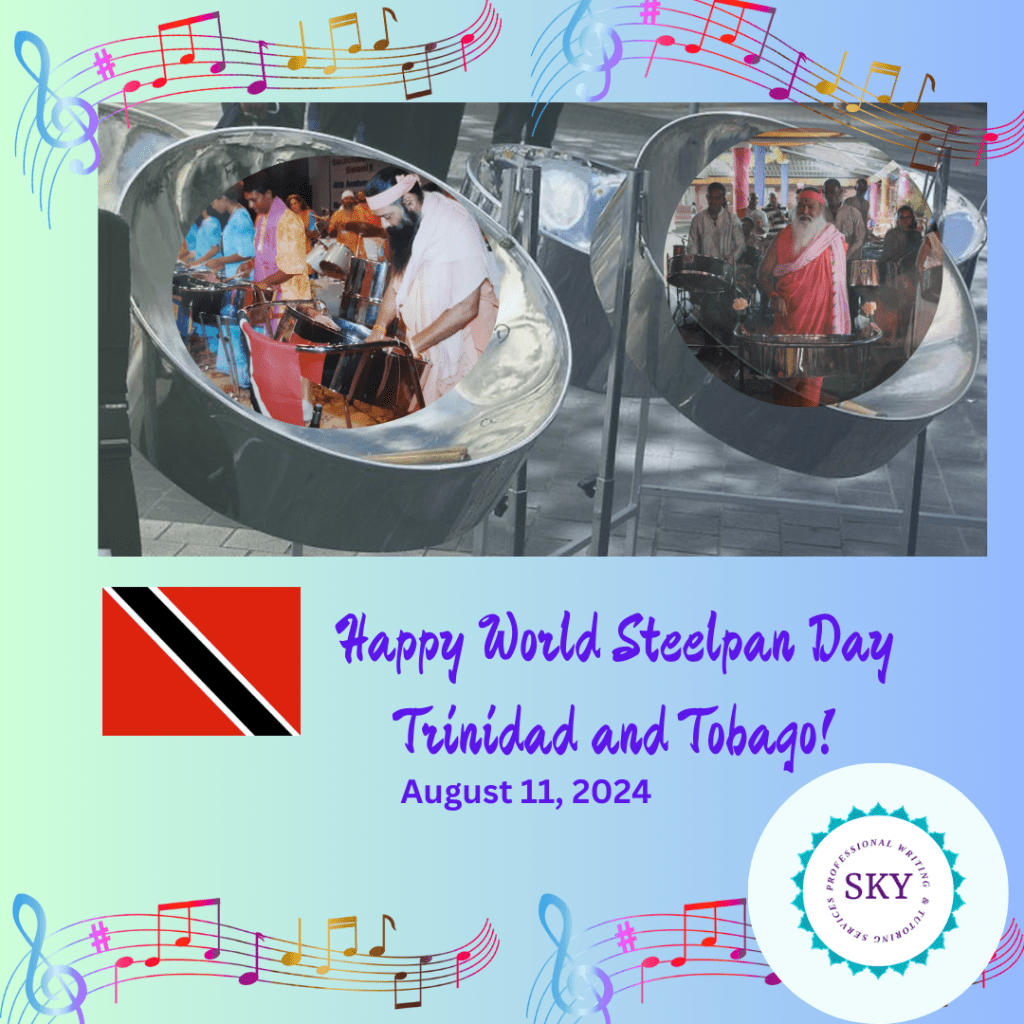
Yes, today, August 11th, 2024, is World Steelpan Day. In recognition of today’s historical significance, this post is dedicated to the steelpan. As such I begin this post by highlighting the Nada Sangama Steel Orchestra led by His Holiness Parama Pujya Sri Ganapathy Sachchidananda Swamiji.
For those who may not be aware, Trinidad and Tobago is the home of the steelpan. This year, on July 3rd, 2024, the steelpan officially became known as Trinidad and Tobago’s national musical instrument following the passage of legislation in Parliament.
Also, for those who may be unaware, the United Nations has now recognized August 11 as World Steelpan Day. Just a few days ago, on August 9, 2024, Trinidad and Tobago achieved another milestone in securing the steelpan as its own when it attained a geographical indicator (GI) for the manufacturing of steelpans. This was approved by the Trinidad and Tobago IP (Intellectual Property) office and therefore gives all steelpan manufacturers and producers the right to affix the GI branding once established standards of production are applied.
The steelpan is an acoustic instrument with a rich cultural history that reflects the creativity and resilience of the people of Trinidad and Tobago. This distinctive instrument, recognized for its unique and captivating sound, has grown from modest origins to become a global symbol of Trinidad and Tobago’s culture and a staple in diverse music genres.
The steelpan’s story dates back to the early 20th century in Trinidad and Tobago. At that time, under British colonial rule, the African descendants who made up much of the population were prohibited from using their traditional drums in their cultural and religious ceremonies. In response to these restrictions, they began experimenting with alternative materials to create new instruments, which eventually led to the creation of the steelpan.
The first steelpans were crafted from discarded oil barrels, which were abundant due to the island’s active oil industry. Musicians would carefully hammer the bottoms of these barrels into concave shapes, with different sizes and depths producing various pitches and tones. This innovative approach laid the groundwork for the steelpan’s development into the instrument we know today.
The 1930s and 1940s were pivotal in the steelpan’s evolution. Innovators like Winston “Spree” Simon and Ellie Mannette played key roles in refining the instrument, exploring different techniques to enhance its sound. Ellie Mannette, often called the “Father of the Modern Steelpan,” was the first to create a steelpan with multiple notes using a full oil barrel, establishing the modern design of the instrument.
As the steelpan continued to develop, its popularity grew. Over the years it has become central to Trinidad and Tobago’s Carnival celebrations, providing the energetic soundtrack to these vibrant festivities. Steelbands are ensembles of musicians playing steelpans of varying sizes and pitches, became a staple of these celebrations and the steelpan became synonymous with Caribbean musical culture. In this post I have also opted to highlight the Phoenix Steel Orchestra which is based in Belmont for the awesome work this very young vibrant band continues to do and both Junior Regrello and Johann Chuckaree who over the recent years have come together to do great work together! I have also opted to highlight Dr Lennox “Boogsie” Sharpe also known as Dr Len Boogsie Sharpe who is a successful and popular composer and arranger of steelpan music.
 Celebrating Existence